Be a T-shaped data scientist
In this blog, I share my two cents about how one can be more valuable as a data scientist.

If you are already an experienced data scientist or working as an experienced data professional you may have noticed several types of data scientists (if you are an aspiring data scientist, check this out ). Some of them are highly focused on machine learning algorithms with different specialization areas, some of them are interested in data as well as feature exploration, and some of them are more working on data analytics and visualization, which is fine. However, this is not the only factor that makes a data scientist more valuable. A T-shaped data scientist is more practical. So let’s talk about it.
A T-shaped professional
Let’s discuss first what a T-shaped professional is. . The letter T is composed of two lines, one horizontal line and another vertical line. A T-shaped professional is a person who has deep and very good expertise in a certain area ( which is the vertical line ) and has some knowledge as well as interest in other related areas ( the horizontal ) which eventually helps to become more efficient and valuable.
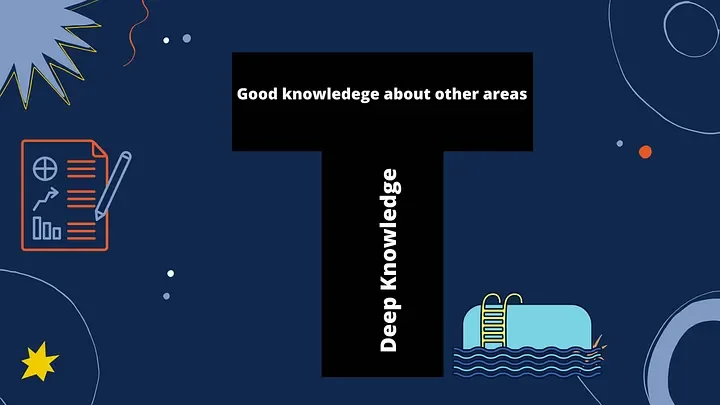
So who is a T-shaped data scientist?
A T-shaped data scientist is a person who has very good and deep knowledge about a certain area(s) of data science ( i.e. Supervised and Unsupervised machine learning, NLP, Reinforcement learning, Computer vision, decision science, etc. ) which is a vertical line and good knowledge and interest in other areas which is the horizontal line. Following other areas/ skills can be a part of the horizontal line.
Business Sense
End to End support
User experience
Project management
Domain knowledge

Now let’s discuss these areas.
Business sense
In the industry, one of the main responsibilities of a data scientist is to add value to the business from data. If you are a data scientist it does not matter what else you have been told this is your main responsibility. Therefore it is extremely important and valuable to understand the business. Understand what are the key business KPIs, understand the needs and the wants of the business and find out the “why” behind it. With this knowledge, you can have another perspective while working on a project. When you have a good business sense this eventually helps you to ask better questions.
End-to-End support
When you are developing machine learning models this has to be used in any sort of form How a machine learning model will be used this question has to be answered at the very beginning of the project. If the inference of the model will be done using REST API then the model will live/interact in an application environment. So additional code needs to be written and tested in order to make the model usable. There are data scientists who are not willing to write that code that could complete the work. Strange isn’t it? Well, don’t be that guy, please.
This is unnecessary work overload if someone else has to do it. If you are using python, learn Flask to create REST API. Learn about Docker and learn how to dockerize an application. Learning these skills and taking care of the application by yourself will make you more productive. You can complete the work more efficiently. This is also not that much work, to be honest.
If the company uses any cloud platform, learning about the cloud for the data infrastructure is absolutely worth it. When you are doing machine learning on a scale there should be an MLOps/ DevOps engineer involved. When you know about the cloud platform, cross-functional teamwork becomes much more efficient and rewarding. This also helps to do the end-to-end work.
User experience
It is important to know who the end user of your work is. Most businesses are user-centric. Depending on the industry, you may need to work or prepare your project based on persona. User feedback also plays an important role sometimes. Observing these facts in an early stage of a project helps to make valuable, impactful work on the first iteration.
Project management
Project management is another skill that not only helps you to organize your work and deliver the results properly but also supports you to accelerate your career. As a data scientist at some point ( most likely after a few months of work ), you have to handle multiple projects. And it is very important to understand and evaluate who are the key stakeholders and their expectations, the data sources needed for the project, what are the business objectives and what is the due date, and the deliverable. Project management for data science topics is a bit different than software / IT topics. Therefore the one who has more hands-on experience with raw data, modeling, and business knowledge can support the project management side very well.
Domain knowledge
You don’t have to be a domain expert to be a well-performing data scientist. However, If you have domain knowledge already or if you can learn about the domain fast, it can definitely help you to see problems from different perspectives. For that, you have to be interested in the domain and always ask questions to those who have more knowledge about the domain. In most cases, if you are working together with a domain expert that should be good enough to deliver your work. If you are working long enough with experience you can learn more about the domain.
So these are the skills that can make a data scientist more valuable. Be curious and gather more skills if that helps you to be better at your work. I hope you find this useful.
Cheers